If you're renovating an inground swimming pool, lining the pool shell with Aqualux should definitely be considered. If you want a tiled look on a fibreglass budget, you've had problems with black spot, or your shell has cracks, then Aqualux will be the perfect solution for your pool.
Giving a high quality, durable result, a vinyl finish like Aqualux is smooth to touch, and comes in a range of fashionable colours and prints. Australian made, Aqualux is easy to keep clean, and custom made to fit each pool. Steps, deep ends and benches are all easily accommodated. Regardless of whether it is a standard size and shape or an intricate, one-off design, a vinyl finish can be made for any pool.
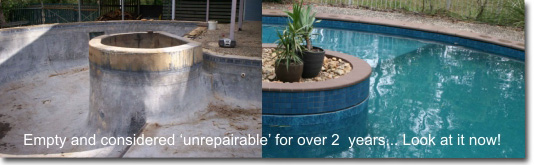 Disused for several years, this old Marblelite pool had been drained, and left sitting
empty. Badly rusted, with illegal fencing, faulty plumbing, hairline cracking and
structural damage, it was in the 'too hard' basket, with long term plans to fill
it in.
Disused for several years, this old Marblelite pool had been drained, and left sitting
empty. Badly rusted, with illegal fencing, faulty plumbing, hairline cracking and
structural damage, it was in the 'too hard' basket, with long term plans to fill
it in.
A renovations specialist presented the owners with the option of a full restoration, lining the cracked shell with Aqualux (in Caribbean print). Unfamiliar with the product, and unsure that the job could be done within budget, they were hesitant to try. As you can see though, they were eventually convinced, and the restoration was a success. From disastrous to delightful, the owners are over the moon with their 'new' pool, and love the smooth, vinyl finish.
Although you may not be familiar with the concept of vinyl to waterproof a swimming pool shell, it is a very popular choice in Europe and the USA, and those who have it LOVE it.
An Aqualux Pool Finish can be used to give new life to all pool builds - tiled, painted or rendered concrete, pebbled pools, fibreglass and of course, vinyl lined panel pools.
Pros and Cons of different inground pool restoration finishes
Paint/Plaster: A common choice. Quick, cheap and effective, no limit to colour options! Drawbacks are a tendency to oxidise and lift, peel and flake. May need re-painting every couple of years, depending on the quality of preparation work, paint used etc. Often used as a 'quick fix' prior to a house sale.
Fibreglass: Can be sprayed on over any surface, over a period of days. Smooth on skin, it is a cost effective choice, and there are plenty of professional pool installers who provide a 'respray' service. Much longer lasting than paint, and like vinyl, it's natural resistance to algae makes it low maintenance. On the downside, if you have had problems with your existing shell cracking, it wont be long before a new one also cracks.
Tiles: Suitable for a concrete pool only. A very attractive finish, but ranges from expensive to extremely expensive, depending on your tile selection!
Quartzcote: An attractive cement/quartz based finish which is rendered on. Comes in a variety of colours, and is also at the more expensive end of the scale.
Pebblecrete: Was very popular in the 80's - long lasting, but can cause cuts and bruising on soft skin during swimming. Vacuums can struggle to keep algae at bay with the rough surface. These days it is no longer just old brown pebbles though, as it can now be mixed with a variety of coloured oxides.
Vinyl: Special additives make it resistant to fungus, making it extremely low maintenance. Very durable, vinyl is 15 times thicker than paint, and will not chip or peel. It is ideal for pools in areas that are exposed to periods of alternate heavy rainfall and drought - a common cause of cracking. Not good if you like to swim with scissors (it can be easy to cut), and it is important to keep your chemical levels to within Australian Standards. Vinyl offers the largest range of colours and patterns of all finishes.
So every finish has it's own pros and cons. Obviously we think a vinyl pool finish is the best option all-round, and that's why we make them.
Can I put a hard finish like pebble or fibreglass into a vinyl lined panel pool?
The short answer is no. Pre-fab pools (such as Poolfab, Tracy Wickham, Pioneer, Gibraltar, Image, Albatross, Black Swan, Champion, Orchid, Plunge, New England, Modular, Marvi, Bel-Aire, Surecast and Cascade - just to name a few!) are specifically engineered to hold a vinyl liner. The only time when you may be able to convert to a hard surface finish is if your pool has a sprayed concrete shell - but unless you built the pool or have the paperwork for it, you wont know if this is the case until the old liner has been removed to expose the shell. An Aqualux pool interior is durable and flexible, and is the ideal choice when renovating a swimming pool that needs to allow for some shell or ground movement. See more about replacing a vinyl pool liner here.